Before the money moves, someone calls.
Callback verification has an AI agent text and call the account holder on the number on file when a payment is held, ask whether they made the request, and return the answer to your system as typed, signed fields. Anything but a clear yes stays on hold for a person.
Calls are billed per talk minute and texts per message. Connecting your own payments system is on your side: it sends a signed request and checks a signature.
Watch one case
A $20,000 redemption, a text, a call, and a signed answer.
Built in one conversation
Usually days. About ten minutes with Octo.
You describe the job in one message. Octo builds all four pieces and asks before it does anything that counts. There is no drag and drop, and no technical skills are needed for this part.
An AI agent
It checks who it is speaking to, reads the request back and asks one question. Its instructions say never to ask for a password and to give no financial advice.
A Dialog Insight
Five typed fields instead of a transcript: the case, the outcome, whether the request was recognized, why it is on hold, and a summary.
A workflow
A case comes in, the text goes out, and the call waits for its result. No polling and no second workflow.
A signed result
A signed message back to your system, so it can check where the answer came from before it acts.
What happens on a case
A held payment, a phone that rings, an answer your system can read.
The case arrives
From a button, or on its own.
An operator presses a button, or your payments system sends the case the moment it flags a payment.
The text, then the call
From one toll-free number.
The heads-up says who is calling and why, and that you will never ask for a password. Then the same number rings.
The answer comes back
Typed and signed, a few seconds after hang-up.
The workflow waits for the call to end and for its analysis, then sends the fields to your system.
What your team sees
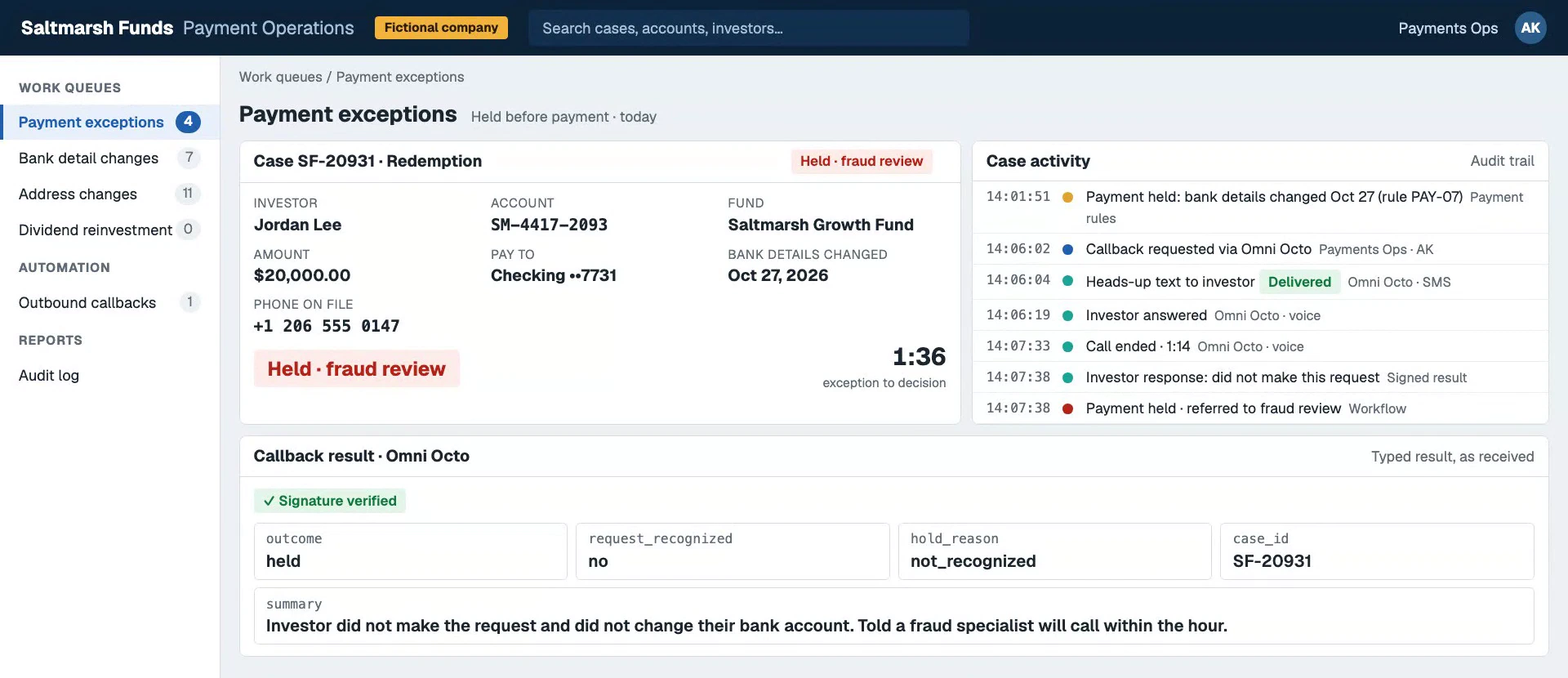
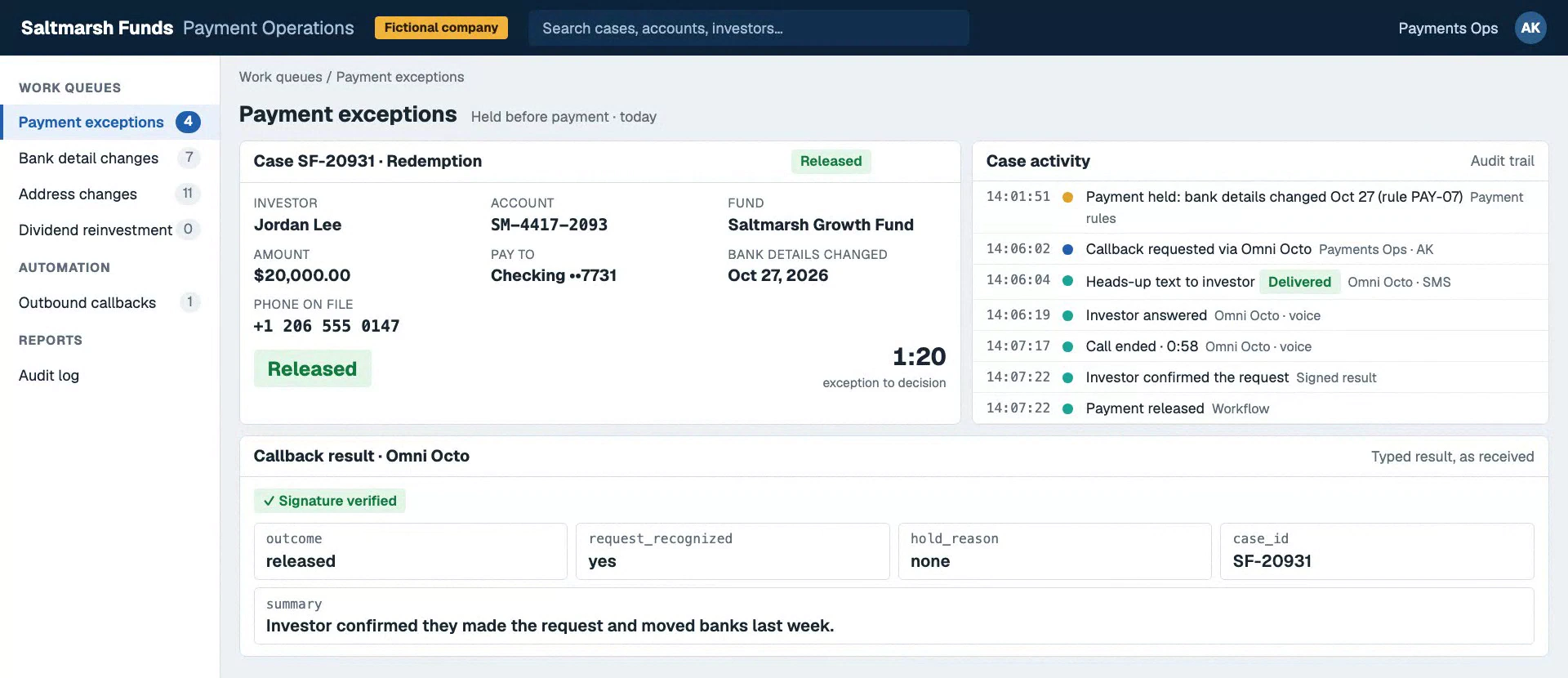
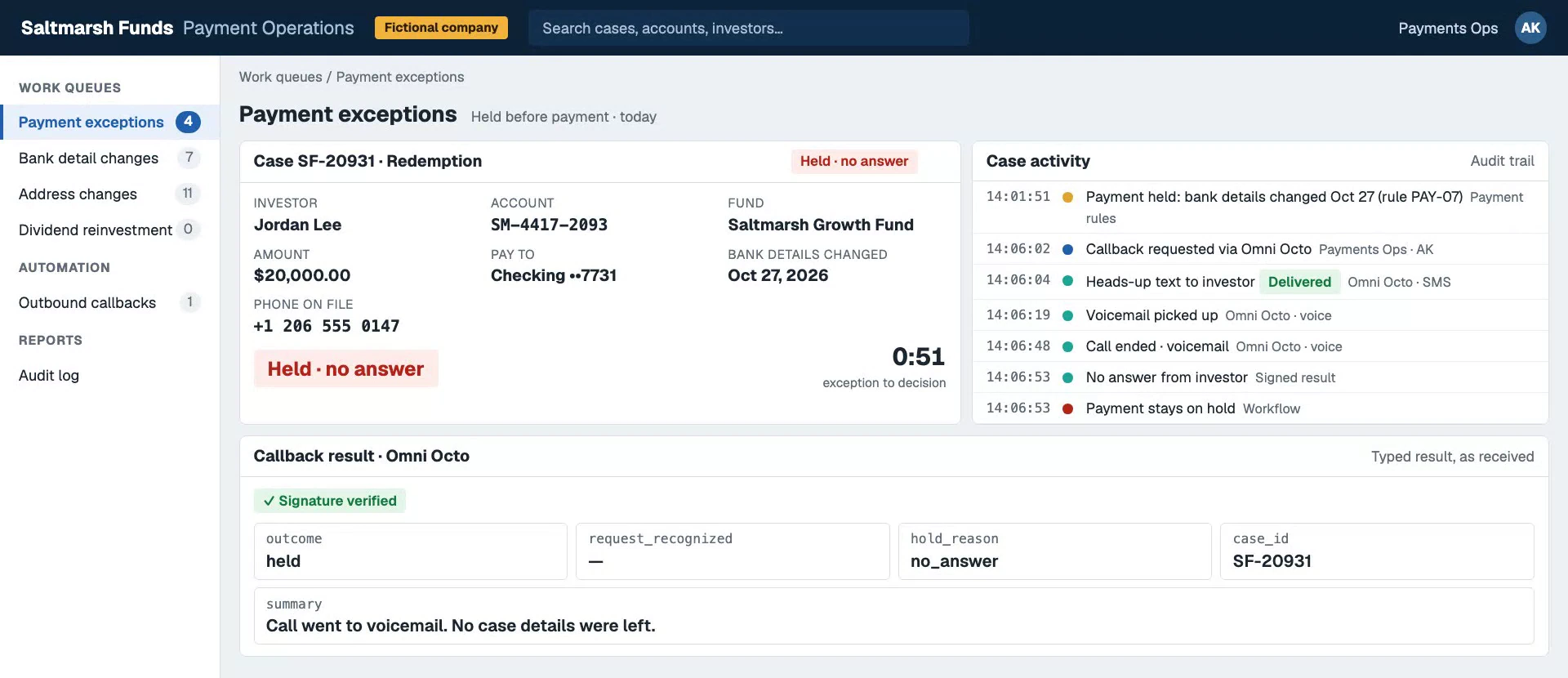
Three results, on a screen of your own.
This console is a stand-in we built to show the idea, for a fictional company. Omni Octo sends the result; your own system can show it however it likes.
What is actually happening
The parts that keep your team in charge.
It never touches the money
Omni Octo has no connection to your payment rails. Treat anything other than outcome released as held, including a missing field or a result that never arrives.
your system decides · fails closed on your sideThe answer is fields, not a recording
Each field can be a fixed set of allowed values, so your system reads held or released rather than a sentence somebody has to interpret.
typed fields · signed resultA person decides what happens next
Held cases go to your team, with the whole conversation and the same fields in Conversations. You can also add a step where a named person approves before a release.
full transcript · optional approval stepIt keeps calling hours
Calls and texts respect quiet hours by default. Outside them the step is skipped, not delayed, so a late case comes back unanswered rather than ringing at midnight.
quiet hours on by defaultWhat it does not do
It does not prove who answered. The script is an instruction to the agent, not a technical block, so test it on your own phone. Replies to the text go to whichever agent answers that number, so route them before you go live.
a callback, not identity verificationQuestions
The things people actually ask.
- Does Omni Octo move or stop the money?
- No. It has no connection to your payment rails. Your system holds the payment and decides what to do with the answer. All Omni Octo sends back is the answer, signed so your system can check where it came from.
- How long does it take to build?
- A build like this usually takes days. Octo builds the agent, the Dialog Insight and the workflow in about ten minutes, in one conversation, with no drag and drop and no technical skills for that part. Pointing your own system at it and making the test calls is the rest of an hour, and needs someone who can change your system.
- Is this identity verification?
- No. The agent asks whether it is speaking to the person named on the case and takes their word for it. What makes it a callback is that you call the number on file, so do not call a number that arrived with the request.
- What happens if nobody answers?
- The case comes back held, with the reason no_answer. A voicemail counts as unanswered, and the agent should not leave case details in a message.
- Can it run on its own, or does someone press a button?
- Either. An operator can press a button on your screen, or your system can send the case by itself the moment it flags a payment. Both reach the same workflow.
- Can it call at any hour?
- No. By default calls and texts go out between 9am and 8pm in every time zone of the person’s country, which for the US and Canada works out to 9am to 4pm Pacific in winter. Outside those hours the step is skipped rather than delayed, and the case comes back as no_answer.
- How accurate are the fields?
- They are an AI’s reading of a conversation. They are usually right, and they can be wrong. That is why anything but a clear yes is held, and why you can add a step where a named person approves before a release.
Keep reading
Related jobs you can hand over.
Calls are billed per talk minute and texts per message. Connecting your own payments system is on your side: it sends a signed request and checks a signature.